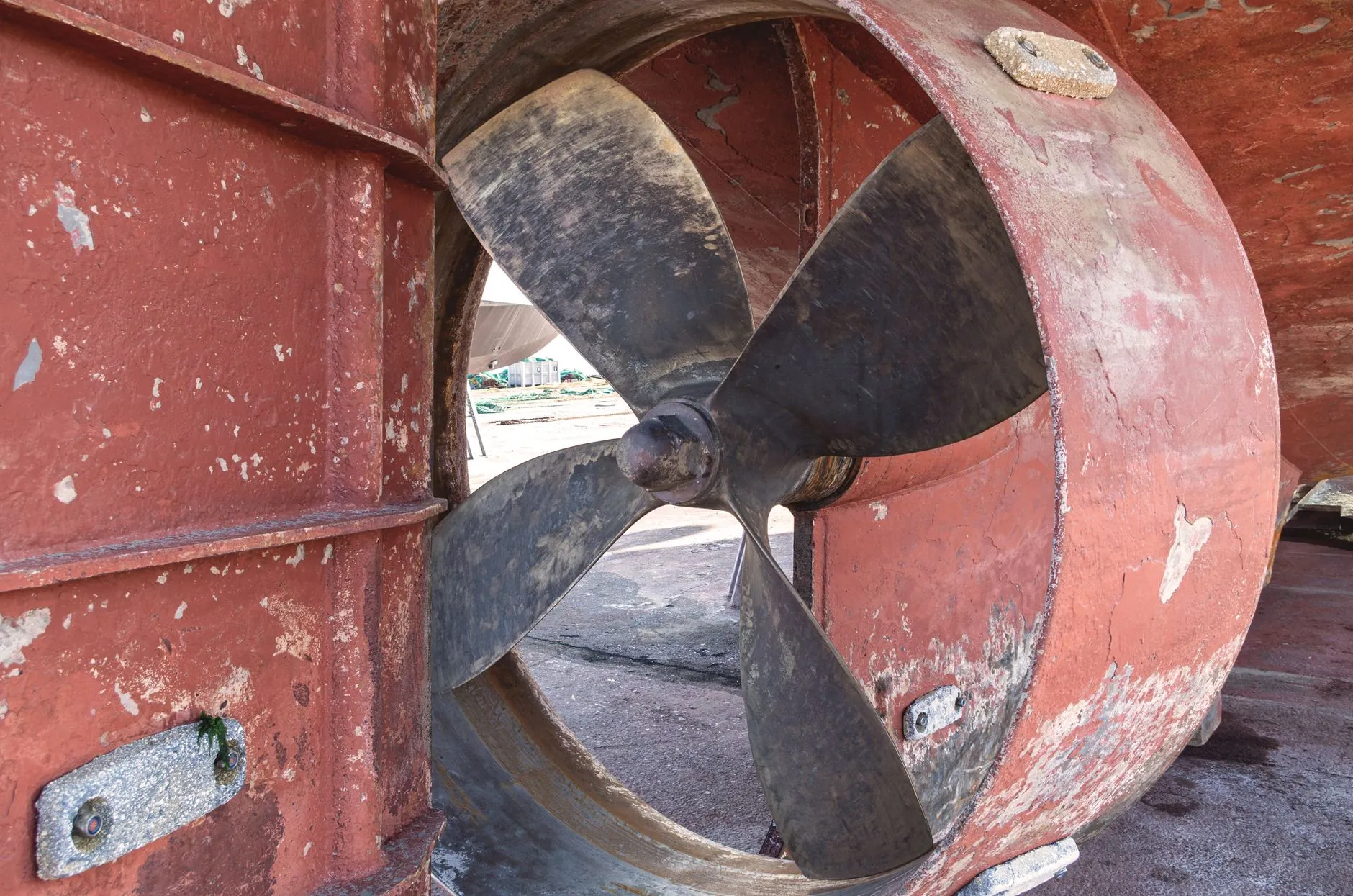
Guide 06 Marine engineering and ship repair
Propeller shaft survey intervals under IACS UR Z21
IACS UR Z21 governs when a ship's propeller shaft and tube shaft must be surveyed. Oil or closed-loop fresh-water lubricated shafts are due every 5 years by Method 1, 2 or 3; keyless propellers can go up to 15 years between full Method 1 or 2 withdrawals, with Method 3 surveys allowed between them and extensions possible inside limits.
- Topic
- Marine engineering and ship repair
- Checked
- 23 September 2026
- Sources
- 2
- Questions
- 6
01
What a tailshaft survey covers
A tailshaft (propeller shaft) survey is the classification survey of the shaft, its bearings and its seals. The full version draws the shaft out, examines the shaft, seals and bearings, removes the propeller, and crack-tests the forward end of the taper and keyway.
Bearing clearances are checked, and weardown is recorded once the shaft and propeller are reassembled. The scope and depth of the survey depend on the propeller connection, oil-lubricated, water-lubricated or keyless, and on which of the three permitted methods is used.
02
Method 1 against Method 2
Method 1 draws the shaft fully: shaft, seals and bearings are examined directly, with crack detection carried out at the taper or the flange. It is the most thorough option and the default where a ship does not qualify for a lighter method.
Method 2 does not draw the shaft. The propeller is removed for crack detection at the taper and keyway, weardown is recorded, accessible parts are inspected, and the seals are confirmed satisfactory. Method 2 carries prerequisites, such as a record of stern tube oil analysis, and UR Z21 also allows a Method 3 chosen by propeller connection type and by which prerequisites a ship meets.
03
The interval, and how it can be extended
For oil-lubricated or closed-loop fresh-water-lubricated shafts, UR Z21 sets a survey every 5 years. For keyless propellers, the interval between two Method 1 or Method 2 surveys, with up to two Method 3 surveys between them, may not exceed 15 years.
An extension is possible after an extension survey: up to 2.5 years in a single extension, up to two consecutive 1-year extensions, or a single 3-month extension. UR Z21 Rev.4 allows stepping up from a shorter extension type to a longer one on the same shaft, on terms set out in the standard, rather than barring any further extension outright. The extension survey checks weardown, seals, oil condition and the shaft's records, and class makes the final call; the flag Administration may add its own requirements.
As a prerequisite for a Method 2 or Method 3 survey, UR Z21 requires stern tube lubricating oil analysis at intervals not exceeding 6 months, with fresh-water sampling on the same cycle for closed-loop water-lubricated systems. Those records are reviewed at the shaft survey.
04
Why the taper and keyway are crack-tested
The forward end of the propeller taper, and any keyway cut into it, sees high bending and torsional stress concentration, plus a corrosion risk if seawater reaches it, so fatigue cracks tend to start there rather than elsewhere on the shaft.
UR Z21 requires an approved surface crack detection method, such as magnetic particle or dye penetrant testing, applied all around the forward taper whenever the propeller is removed. A keyed connection, which carries torque through a key in the taper, is the case where this check matters most; a keyless, hydraulically fitted connection has no keyway but is still crack-tested on the taper surface.
Asked next
Questions people also ask
Propeller shaft survey intervals under IACS UR Z21
What is a tailshaft survey?
A tailshaft survey is the classification survey of a ship's propeller shaft, its bearings and its seals. Under IACS UR Z21 the full version draws the shaft, examines shaft, seals and bearings, removes the propeller, crack-tests the forward taper and keyway, checks bearing clearances, and records weardown after reassembly.
How often is a propeller shaft survey required?
For oil-lubricated or closed-loop fresh-water-lubricated shafts, IACS UR Z21 sets a survey every 5 years by Method 1, 2 or 3, depending on the propeller connection and on prerequisites being met. Keyless propellers can go up to 15 years between full Method 1 or 2 withdrawals, with Method 3 surveys allowed between them.
What is the difference between Method 1 and Method 2 tailshaft surveys?
Method 1 draws the shaft fully to examine shaft, seals and bearings directly, plus crack detection at the taper or flange. Method 2 does not draw the shaft: the propeller is removed for crack detection at the taper and keyway, weardown is recorded, and seals are confirmed satisfactory, subject to prerequisites such as oil analysis records.
Can a propeller shaft survey be extended?
Yes, within limits. IACS UR Z21 allows one 2.5-year extension, up to two consecutive 1-year extensions, or a single 3-month extension after an extension survey, and Rev.4 permits stepping up from a shorter extension type to a longer one on the same shaft under stated conditions. The extension survey checks weardown, seals, oil condition and records, and class decides case by case.
How often should stern tube oil be analysed for a Method 2 or Method 3 shaft survey?
As a prerequisite for a Method 2 or Method 3 shaft survey, IACS UR Z21 requires stern tube lubricating oil analysis at intervals not exceeding 6 months, and fresh-water samples on the same interval for closed-loop water-lubricated systems. The records are reviewed when the shaft survey falls due.
Why is the propeller taper and keyway crack-tested?
The forward end of the propeller taper, and any keyway, carries high bending and torsional stress plus a corrosion risk if seawater gets in, so fatigue cracks start there. IACS UR Z21 requires an approved surface crack detection method, such as magnetic particle or dye penetrant testing, around the forward taper whenever the propeller is removed.
Checked against
Sources
- 01UR Z21 Rev.4, Surveys of Propeller Shafts and Tube Shafts, International Association of Classification Societies, hosted by Türk Loydu
- 02About IRClass, Indian Register of Shipping
This guide explains how the system works in general, as the documents above describe it, and was last checked on 23 September 2026. Rules and thresholds change: the governing document is the authority, not this page.
On this site
Where this meets the work
Have a requirement rather than a question?
Send the specification, the part or the drawing. The first reply says what we can do and what we need from you.