Guide 06 Marine engineering and ship repair
Dry docking intervals and extended dry docking (IRS)
Under the IMO Harmonized System of Survey and Certification, a cargo ship's outside bottom must be inspected at least twice in every five-year period, usually in dry dock. The Extended Dry-Docking (EDD) scheme, published by the Indian Register of Shipping, lets an eligible ship stretch that interval to 7.5 years.
- Topic
- Marine engineering and ship repair
- Checked
- 23 September 2026
- Sources
- 4
- Questions
- 6
01
The standard dry-docking interval
A cargo ship's outside bottom must be inspected at least twice in every five-year period, with one of those inspections linked to the renewal survey. These inspections are normally carried out in dry dock, although the flag Administration may accept an in-water inspection for one of the two.
Naval ships do not follow this commercial survey cycle; they are refitted on their own planned maintenance schedule, set by the operating navy rather than a classification society.
02
In-water surveys, and the Extended Dry-Docking scheme
An in-water survey (IWS) examines the underwater hull, propeller, rudder and sea inlets while the ship stays afloat, using approved divers or a remotely operated vehicle, with a class surveyor attending. It can be accepted in place of a dry-dock bottom inspection, subject to conditions on the ship's age, type and hull markings.
The Extended Dry-Docking scheme, based on IACS Recommendation 133 and published by the Indian Register of Shipping as Technical Circular 043/2022, lets an eligible ship replace two dry dockings with consecutive in-water surveys, stretching the docking interval from 5 to 7.5 years. It needs class and flag approval, applies only to ships up to 10 years old, and excludes several ship types, including passenger ships, bulk carriers, oil tankers, ships fitted with propulsion thrusters and ships with keyed-taper propellers.
03
What a class surveyor checks in dry dock
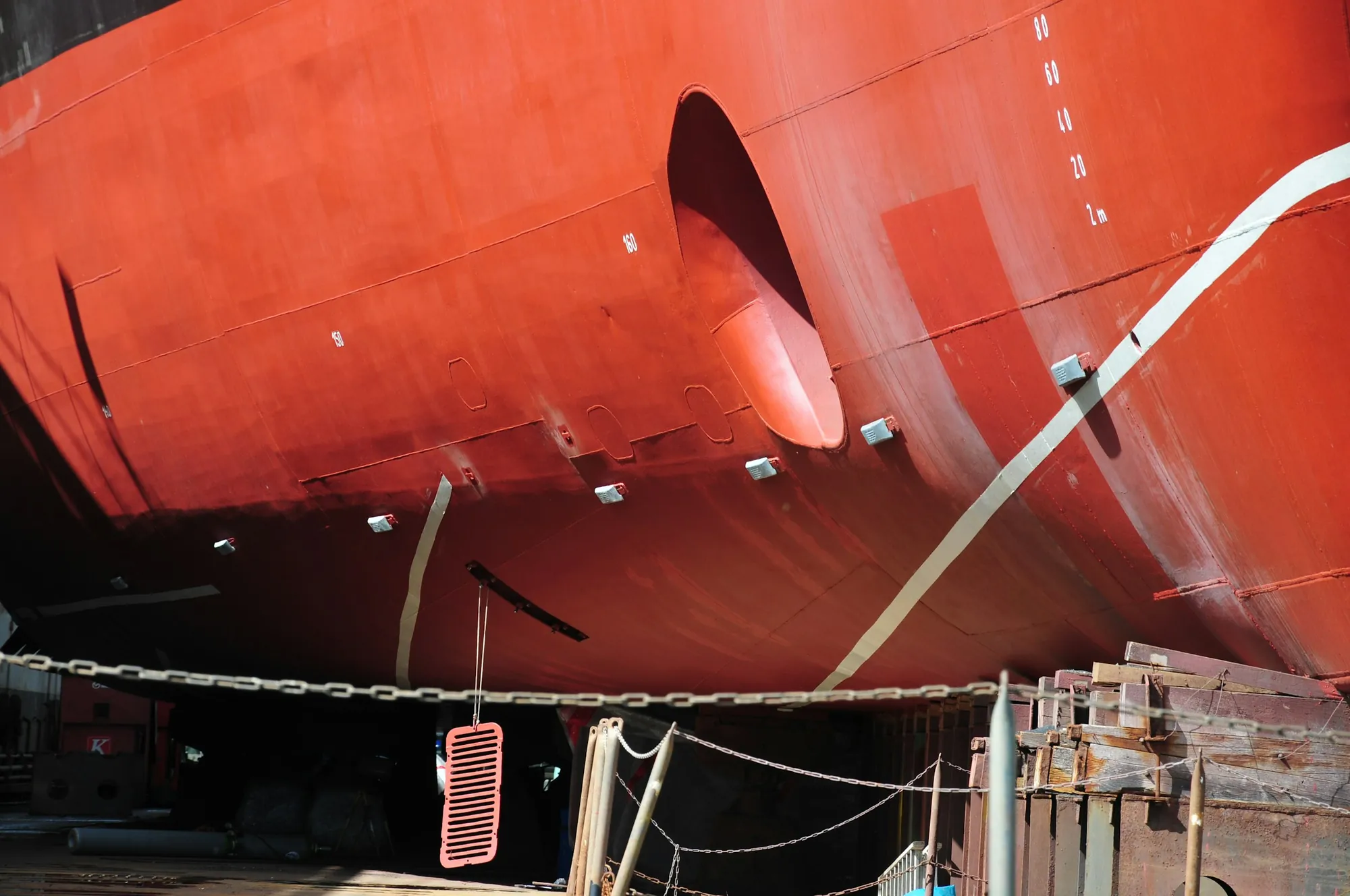
In dry dock the surveyor examines the outside bottom and shell plating, the rudder, pintles and bearing clearances, the propeller for damage, the sea chests, sea valves and their fastenings, and the anodes and coating. Stern tube bearing weardown is recorded at the same time.
If a tailshaft survey is due, the propeller is removed and the shaft taper and keyway are crack-tested as part of the same docking, so yards commonly plan a hull docking and a due shaft survey together to avoid a second lift.
04
Typical dry-dock scope of work
Beyond the survey items, a typical dry docking includes hull washing and blasting, bottom inspection and plate thickness gauging, renewal of sacrificial anodes, and opening, cleaning and overhauling the sea chests and sea valves.
- Hull washing, blasting and bottom inspection
- Plate thickness gauging and anode renewal
- Sea chest cleaning and sea valve overhaul
- Propeller polishing and inspection
- Rudder and pintle clearance checks
- Stern tube weardown readings, and a tailshaft survey if due
- Repainting with anticorrosive and antifouling coats
Asked next
Questions people also ask
Dry docking intervals and extended dry docking (IRS)
How often does a ship need dry docking?
Under the IMO Harmonized System of Survey and Certification, a cargo ship's outside bottom must be inspected at least twice in every five-year period, with one inspection linked to the renewal survey. These are normally done in dry dock, though the flag Administration may accept an in-water inspection for one of them.
What is the Extended Dry-Docking (EDD) scheme?
The Extended Dry-Docking scheme, based on IACS Recommendation 133, lets an eligible ship replace two dry dockings with consecutive in-water surveys and stretch the docking interval from 5 to 7.5 years. It needs class and flag approval, applies only to ships up to 10 years old, and excludes several ship types.
Which ships are excluded from the Extended Dry-Docking scheme?
As published by the Indian Register of Shipping for Panama-flagged ships, the scheme excludes passenger ships, bulk carriers, oil tankers, ships fitted with propulsion thrusters, ships with keyed-taper propellers and high-speed craft, among other categories, and it applies only to ships up to 10 years old. Other flags and class societies may set different conditions, so eligibility needs checking case by case.
What is an in-water survey?
An in-water survey examines the underwater hull, propeller, rudder and sea inlets while the ship stays afloat, using approved divers or a remotely operated vehicle, with a class surveyor attending. It can be accepted in place of a dry-dock bottom inspection, subject to conditions on the ship's age, type and hull markings.
What does a class surveyor check during dry docking?
In dry dock the surveyor examines the outside bottom and shell, rudder, pintles and bearing clearances, propeller for damage, sea chests, sea valves and their fastenings, anodes and coating, and records stern tube bearing weardown. If a tailshaft survey is due, the propeller is removed and the taper and keyway are crack-tested.
What work is typically done during a ship's dry docking?
Typical dry-dock work includes hull washing and blasting, bottom inspection and plate thickness gauging, renewal of sacrificial anodes, opening and cleaning sea chests and overhauling sea valves, propeller polishing and inspection, rudder and pintle clearance checks, stern tube weardown readings, and repainting with anticorrosive and antifouling coats.
Checked against
Sources
- 01Technical Circular 043/2022, Extended Dry-Docking scheme, Indian Register of Shipping (IRClass)
- 02Dry docks and surveys: types, requirements, regulations, Marine Public (excerpt)
- 03Scope of dry-docking inspection and repair, Diesel Ship
- 04UR Z21 Rev.4, Surveys of Propeller Shafts and Tube Shafts, International Association of Classification Societies, hosted by Türk Loydu
This guide explains how the system works in general, as the documents above describe it, and was last checked on 23 September 2026. Rules and thresholds change: the governing document is the authority, not this page.
On this site
Where this meets the work
Have a requirement rather than a question?
Send the specification, the part or the drawing. The first reply says what we can do and what we need from you.