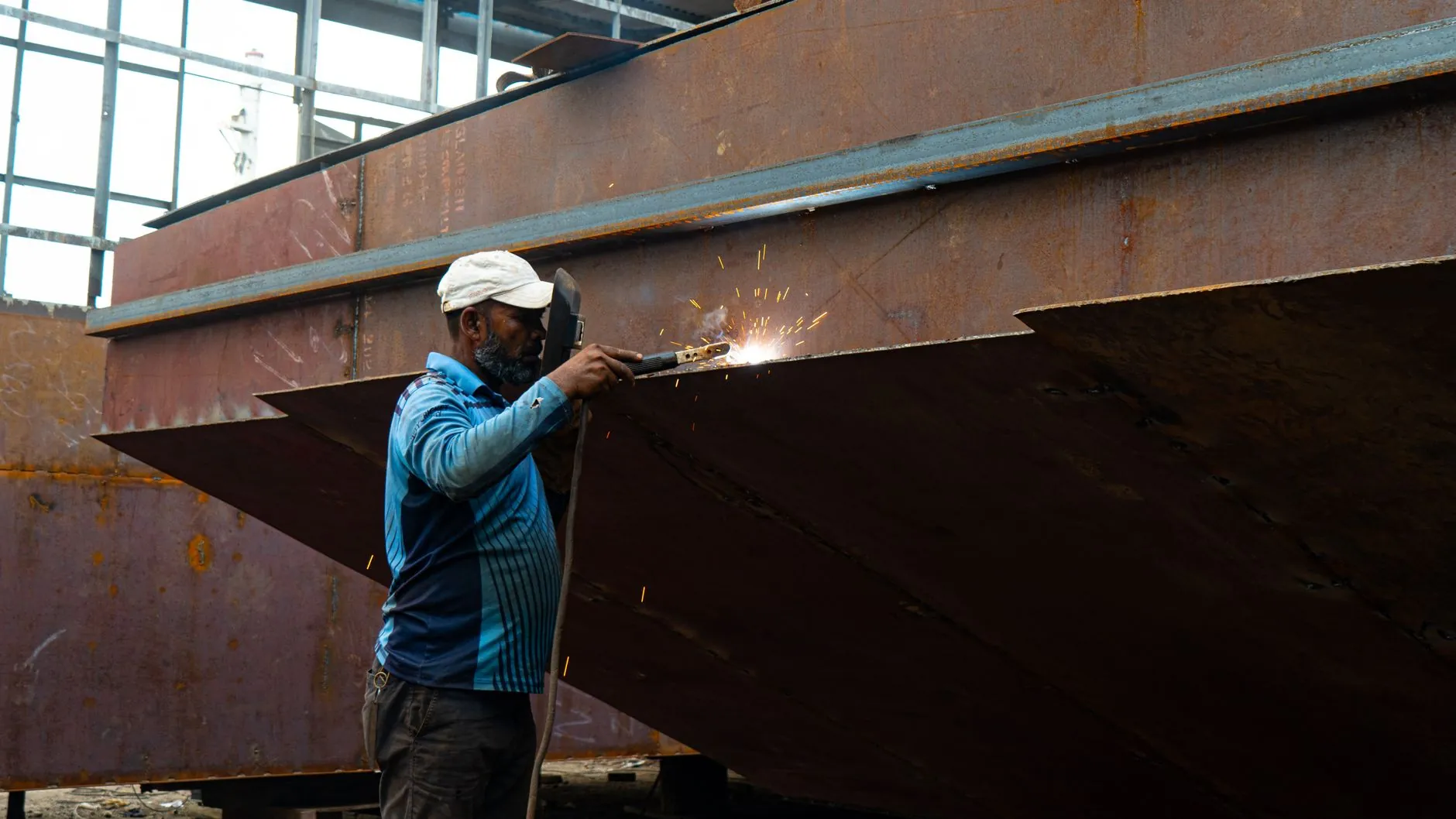
Guide 07 Defence fabrication and interconnection
Which welding and structural steel standards apply to defence fabrication?
Structural steel for fabrication in India is graded under IS 2062 by minimum yield strength and by an impact-test suffix such as BR, B0 or C. Separately, ISO 3834 sets quality requirements for the welding operation itself, ISO 15614-1 qualifies the welding procedure, and ISO 9606-1 qualifies the individual welder who applies it.
- Topic
- Defence fabrication and interconnection
- Checked
- 23 September 2026
- Sources
- 3
- Questions
- 6
01
IS 2062 grades: E number and impact suffix
IS 2062 names a structural steel grade by two things: an E number giving the minimum yield strength in megapascals, such as E250 or E350, and a letter suffix that sets whether and how the steel is impact tested. Grade A needs no impact test at all. Grade BR carries an optional impact test at room temperature.
Grade B0 requires a mandatory impact test at 0 degrees C, and grade C requires a mandatory impact test at minus 20 degrees C and must be killed steel, meaning it was deoxidised during casting to remove dissolved oxygen. The suffix, not the E number alone, is what a designer checks against the expected service temperature and any shock loading.
- A: no impact test required
- BR: optional impact test at room temperature
- B0: mandatory impact test at 0 degrees C
- C: mandatory impact test at minus 20 degrees C, killed steel
02
Choosing between E250 and E350
E250 and E350 are the two structural grades most often compared for fabricated frames and handling equipment. E350 carries a higher minimum yield strength, around 350 MPa against roughly 250 MPa for E250, which allows a lighter section for the same load. The trade-off is a higher carbon equivalent, which means welding procedures need more care with preheat and consumable selection to avoid hardening in the heat-affected zone.
The impact sub-grade, BR, B0 or C, is chosen on service temperature and shock loading rather than on the E number, so a low-temperature or impact-loaded application can call for the C suffix on either E250 or E350 steel, not just on the higher-strength grade.
03
Qualifying the welding procedure and the welder
ISO 3834 sets quality requirements for fusion welding across a fabricator's whole operation: review of the job's requirements, qualified procedures and personnel, suitable equipment, controlled materials, inspection and records. Part 2, the comprehensive level, is what defence, rail and pressure equipment work usually asks for, and it sits above the two lighter parts of the standard.
Underneath ISO 3834 sit two more specific qualifications. ISO 15614-1 qualifies a welding procedure for arc and gas welding of steels by welding a test coupon, examining and mechanically testing it, and recording the result as a Welding Procedure Qualification Record that supports production welding within its tested range. ISO 9606-1 separately qualifies the individual welder, through a test weld made and examined under defined conditions of process, material, joint, position and thickness, with the resulting certificate valid only for the range it covers and needing confirmation or revalidation to stay current.
04
WPS, PQR and WPQ, in plain terms
A Welding Procedure Specification, WPS, is the written recipe: every variable a welder must follow for a given joint, from current and voltage to preheat and consumable. A Procedure Qualification Record, PQR, is the proof that the recipe works: the record of the test weld and the mechanical test results that support it. A Welder Performance Qualification, WPQ, is the proof that a specific welder can follow that recipe and produce a sound weld.
In short, the WPS is the recipe, the PQR is proof of the recipe, and the WPQ is proof of the welder. A buyer reviewing a fabricator's quality file checks for all three together, since a valid WPS with no PQR behind it, or a welder with no current WPQ, is a gap in the traceability chain rather than a paperwork formality.
Asked next
Questions people also ask
Which welding and structural steel standards apply to defence fabrication?
What does the E number mean in an IS 2062 steel grade?
The E number in an IS 2062 grade states the steel's minimum yield strength in megapascals, so E250 has a minimum yield strength of about 250 MPa and E350 about 350 MPa. The grade also carries a letter suffix, A, BR, B0 or C, that sets whether and how the steel is impact tested, which matters as much as the yield strength for low-temperature or shock-loaded service.
What is the difference between IS 2062 grades BR, B0 and C?
Grade A needs no impact test. Grade BR carries an optional impact test at room temperature. Grade B0 requires a mandatory impact test at 0 degrees C. Grade C requires a mandatory impact test at minus 20 degrees C and must be killed steel, deoxidised during casting. The suffix is chosen against the expected service temperature and any shock loading, independent of the E number.
Should a fabricated frame use E250 or E350 steel?
E350 has a higher minimum yield strength than E250, roughly 350 MPa against 250 MPa, which allows a lighter section for the same load, but its higher carbon equivalent means the welding procedure needs more care with preheat and consumable choice. The impact sub-grade, BR, B0 or C, is selected separately, based on service temperature and shock loading, and can be applied to either E number.
What is the difference between a WPS, a PQR and a WPQ?
A Welding Procedure Specification (WPS) is the written recipe listing every variable for a weld. A Procedure Qualification Record (PQR) is the test weld and mechanical test results that prove the recipe works. A Welder Performance Qualification (WPQ) proves a specific welder can follow that recipe and produce a sound weld. A complete quality file carries all three, not just the WPS.
What does ISO 3834 certification actually require?
ISO 3834 sets quality requirements for fusion welding covering review of the job's requirements, qualified welding procedures and personnel, suitable equipment, controlled materials, and inspection and records. Part 2, the comprehensive level, is what defence, rail and pressure equipment work usually specifies. It works alongside ISO 15614-1 for procedure qualification and ISO 9606-1 for welder qualification rather than replacing either.
How is a welder qualified under ISO 9606-1?
Under ISO 9606-1, a welder makes a test weld under defined conditions of process, material group, joint type, welding position and material thickness, which is then examined visually and by bend, fracture or radiographic testing. The resulting certificate covers only the range of conditions tested and has to be kept valid through periodic confirmation or revalidation rather than being a one-time qualification.
Checked against
Sources
- 01IS 2062:2011, Hot Rolled Medium and High Tensile Structural Steel, Bureau of Indian Standards
- 02ISO 15614-1:2017, Specification and Qualification of Welding Procedures for Metallic Materials, Part 1, International Organization for Standardization
- 03WPS vs PQR vs WPQ explained for buyers, Burnhouse Engineering
This guide explains how the system works in general, as the documents above describe it, and was last checked on 23 September 2026. Rules and thresholds change: the governing document is the authority, not this page.
On this site
Where this meets the work
More in Defence fabrication and interconnection
Have a requirement rather than a question?
Send the specification, the part or the drawing. The first reply says what we can do and what we need from you.