
Type approved product
Battery charging rectifier
A naval battery charging rectifier built to Leo's own drawings, type approved by the Directorate of Quality Assurance (Naval) and qualified against eleven environmental and shock tests.
- Certificate
- DQAN/TAC/CQAE(N)/2026/123
- Authority
- DQA(N)
- Issued
- 3 March 2026
- Part number
- N6130-TV00004
What it does
Battery charging rectifier, type approved by DQA(N)
A battery charging rectifier converts the ship's three phase supply into the direct current that charges a battery bank, and then holds that charge without cooking the cells. On a warship it has to do that while the deck it is bolted to moves, heats, floods, corrodes and takes shock.
This unit was designed here. The certificate names no other manufacturer, and the drawings it was type approved against, LEO/BCR/GA and LEO/BCR/SCH, are Leo's own, approved by Headquarters Eastern Naval Command. That is the difference between a firm that assembles somebody else's product and a firm that owns the design.
The front panel carries what an operator needs and nothing more: phase presence, six alarms, three meters, an output voltage selector, and an input breaker. The photographs on this page are of the delivered units.
The paperwork
What the certificate says
Transcribed from the certificate, not summarised from it. Ask and a copy comes back the same day.
Type approval
- Certificate
- DQAN/TAC/CQAE(N)/2026/123
- Issued
- 3 March 2026
- Authority
- Directorate of Quality Assurance (Naval), Ministry of Defence
- Nomenclature
- Battery Charging Rectifier 450V/130A
- Part number
- N6130-TV00004
- Drawings
- LEO/BCR/GA and LEO/BCR/SCH Rev 02, approved by Headquarters Eastern Naval Command
- Quality assurance plan
- DQAN/QAP/L&W/2024/109
As built
- Input
- 440V AC, three phase, 50 Hz
- Output
- 36V DC, 130A
- Output selector
- 12V, 24V and 36V
- Metering
- Input voltage, DC voltage and DC current, digital
- Annunciation
- Mains high, mains low, phase fail, DC high, DC low, reverse polarity
- Marking
- LEO-BCR-36VDC-130A, made in India
Reissued under letter DQAN/L&W/500427 dated 13 March 2026 to correct the company name. Both documents refer to the same equipment and the same firm.
Qualification
Eleven tests, and the conditions they were run at
Type tested to JSS 55555:2020 Rev-4, reports by DSRI. This is the schedule annexed to the certificate.
| Test | Condition |
|---|---|
| Vibration | 5 to 33 Hz, plus or minus 0.125 constant displacement in x, y and z axes |
| High temperature | Procedure 5, test condition G, 55 plus or minus 3 degrees C, 16 hours |
| Damp heat | Operating temperature 40 plus or minus 2 degrees C, 93 plus or minus 5 percent relative humidity, 16 hours |
| Low temperature | Procedure 4, test condition H, minus 10 plus or minus 3 degrees C, 16 hours |
| Drip proof | Vertical water drip from 1 m for 15 minutes, powered on |
| Tropical exposure | Test condition A, 7 cycles |
| Mould growth | 30 plus or minus 1 degrees C, above 90 percent relative humidity, 28 days |
| Corrosion, salt | Procedure 1 |
| Bump | 1000 bumps plus or minus 10, 40g, 6 ms |
| Shock and impact | NSS Grade I, 120g vertical and 70g lateral, 8 ms, three shocks per face, 18 in total |
| Inclination and tilt | 15 degrees operational, 30 degrees survival, to NES 1004 |
Photographs
The delivered equipment
The client's own photographs of units built and marked.
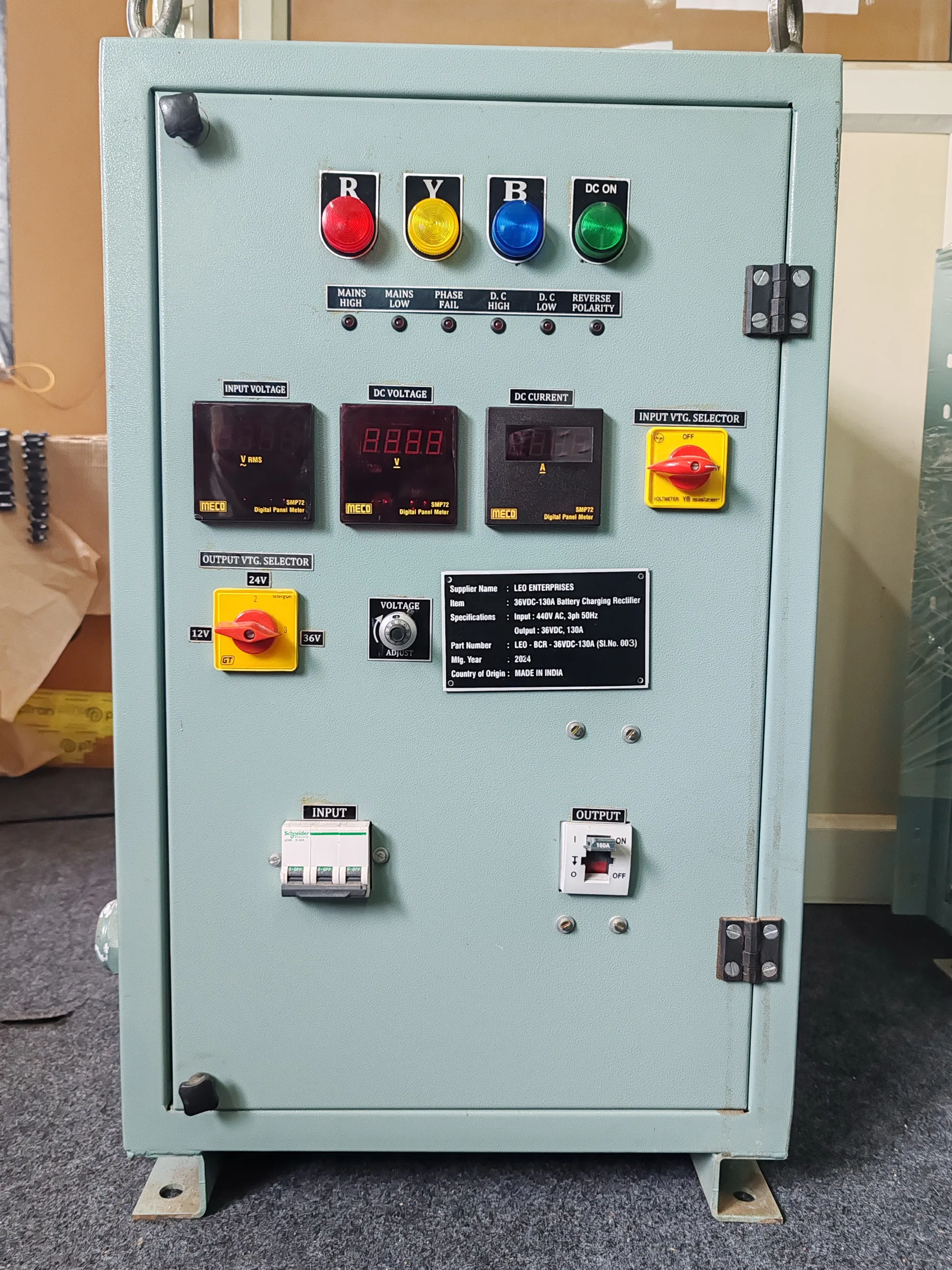
Battery charging rectifier, front panel
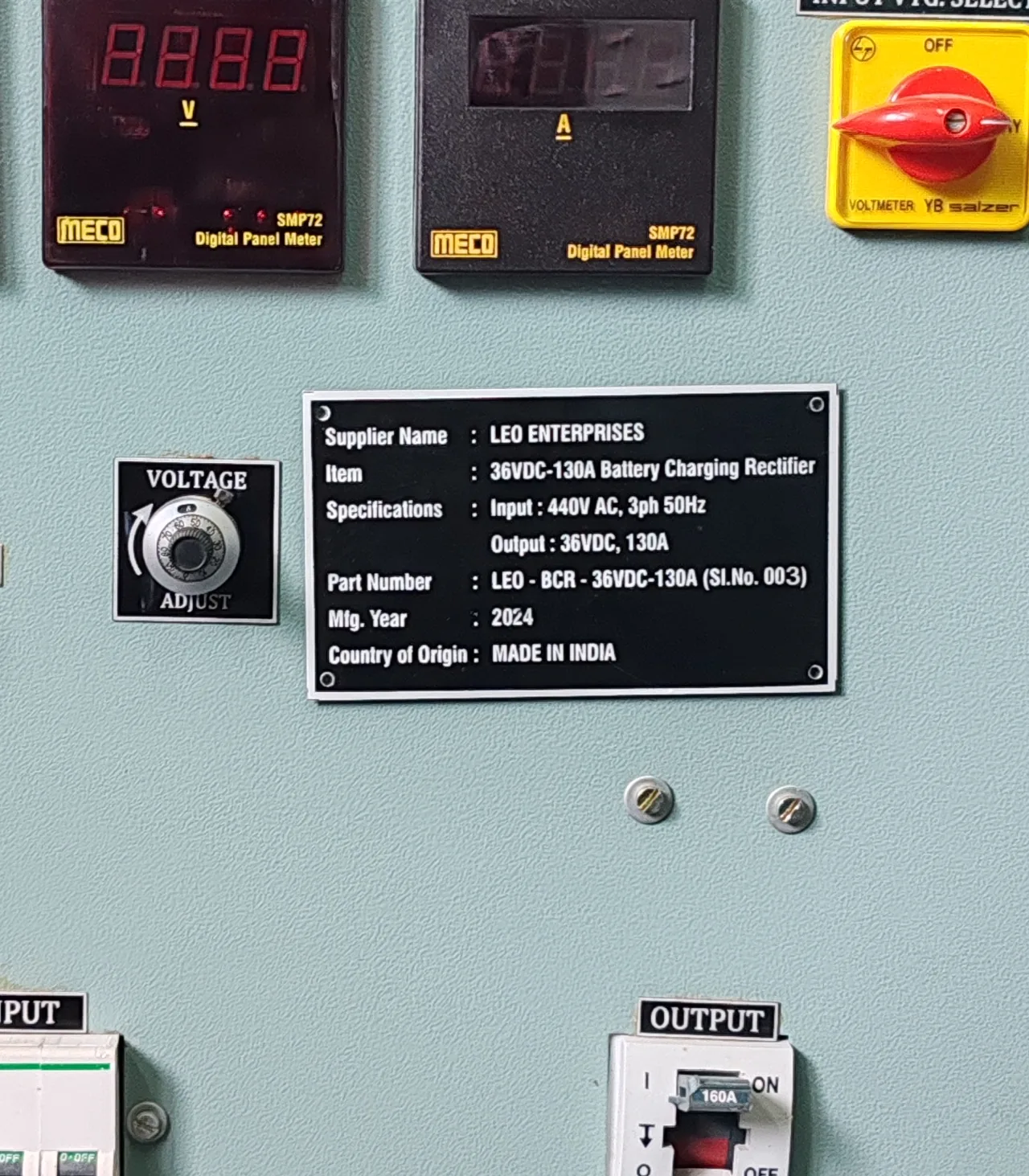
Nameplate: 36V DC, 130A, made in India
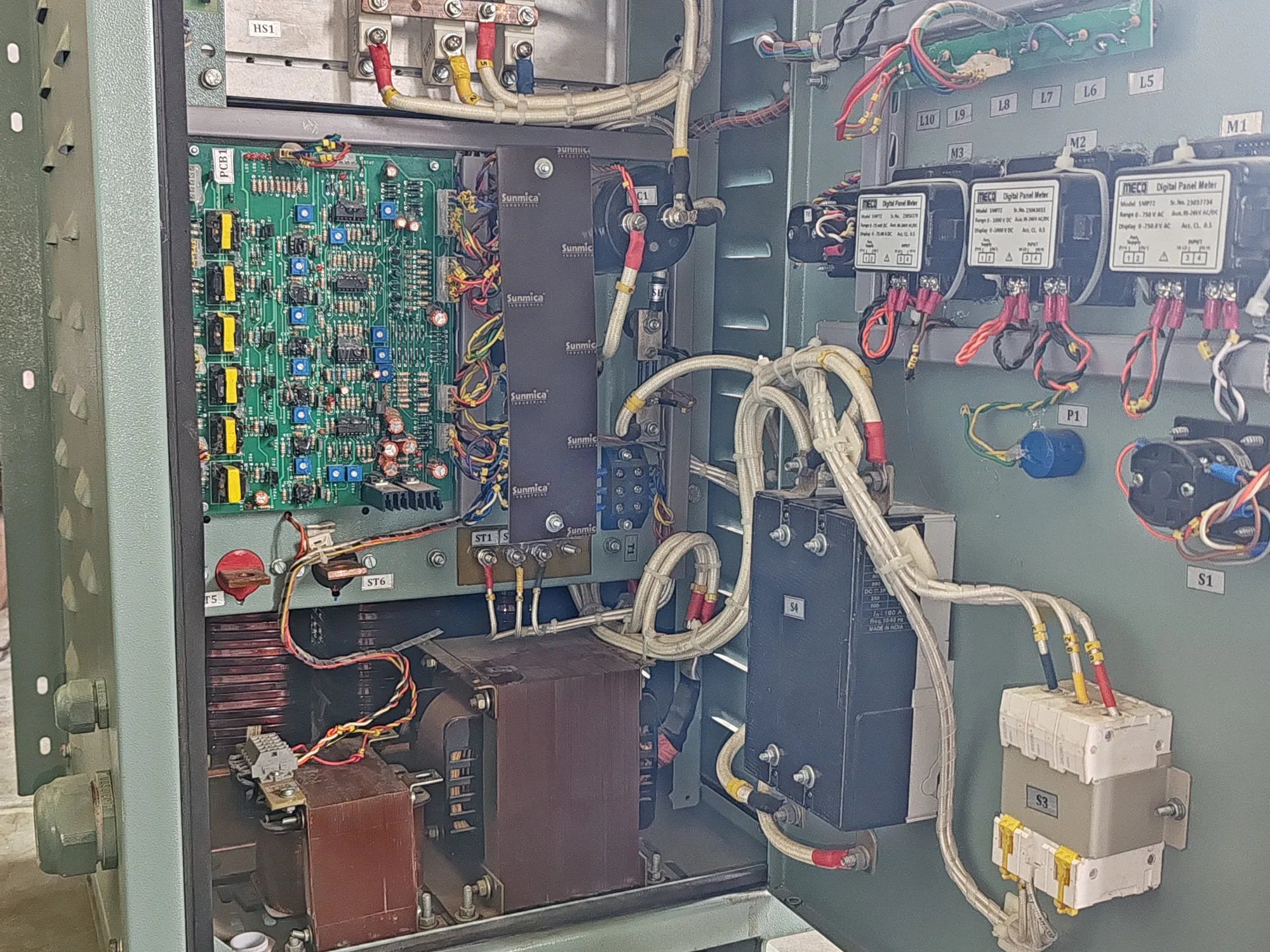
Rectifier internals, door open
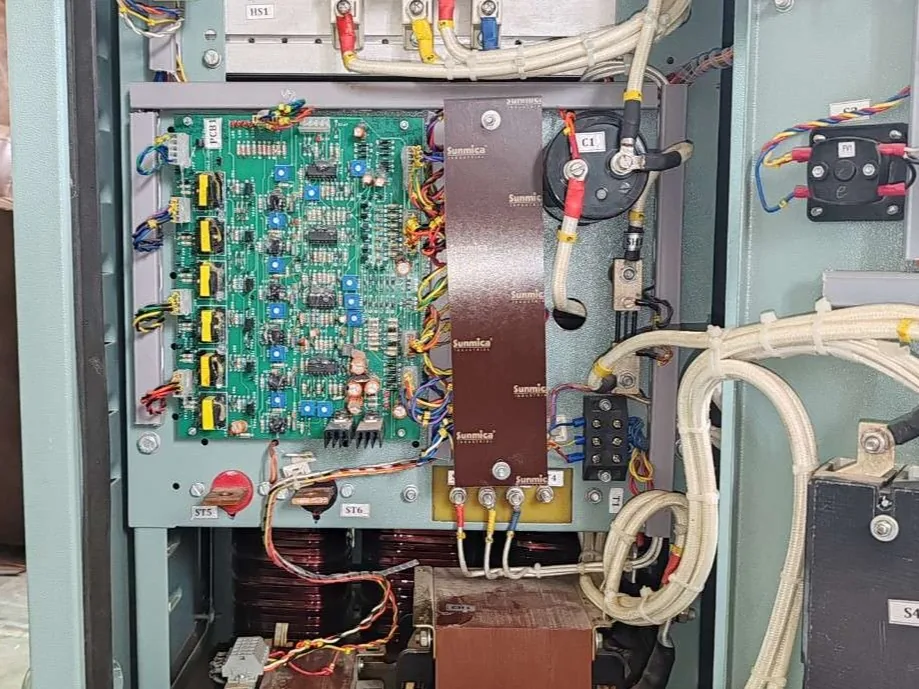
Control board and gate drives
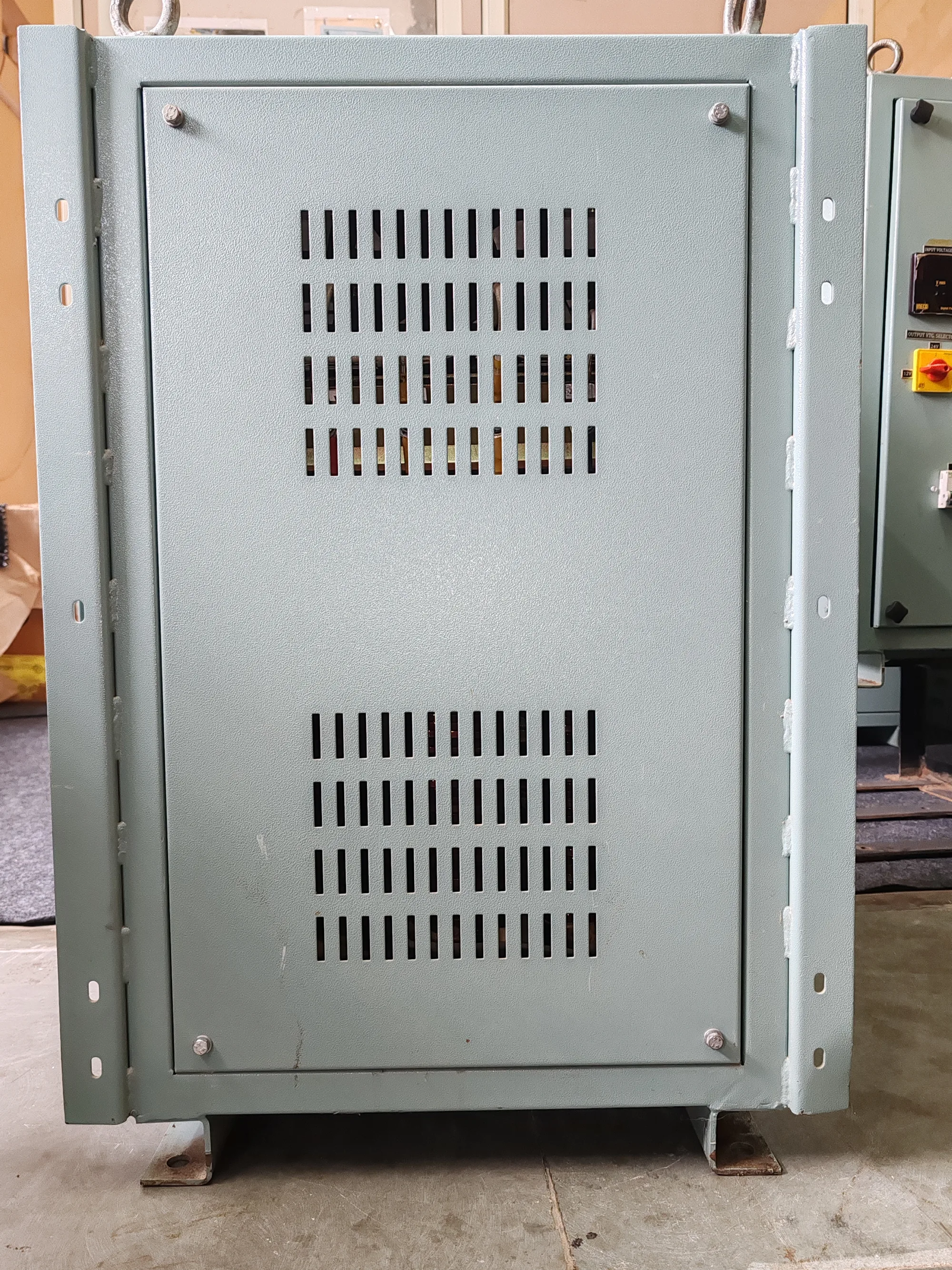
Cabinet, louvred side and lifting eyes
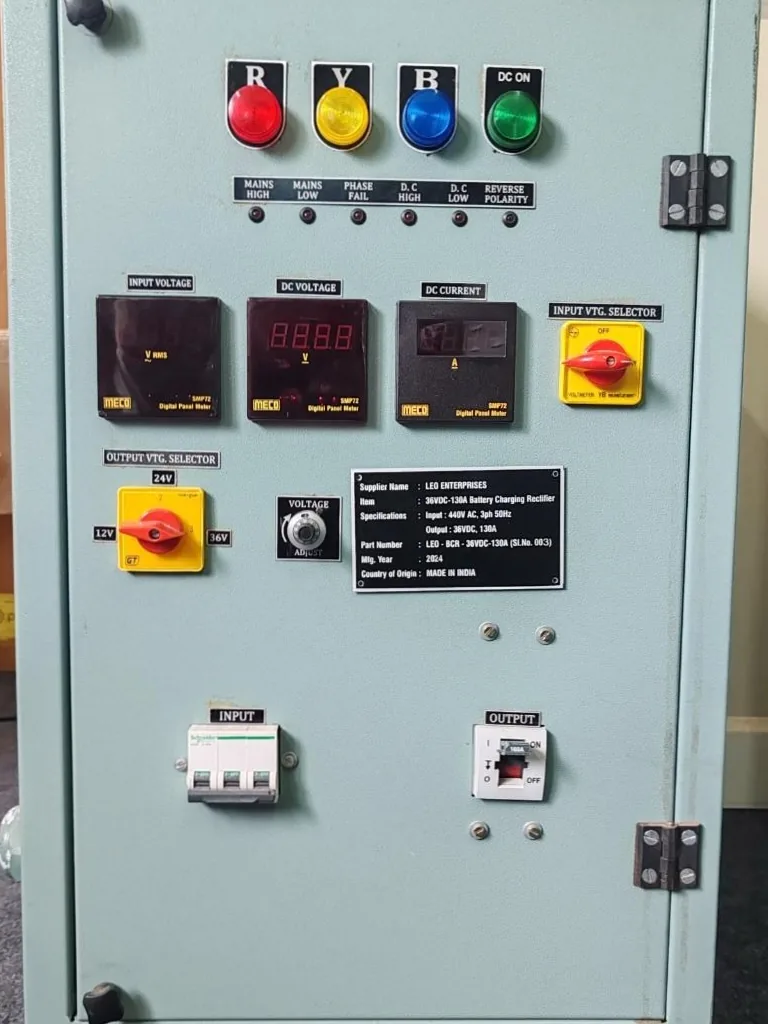
Metering, selectors and voltage adjust
Before we quote
What to send
Send this
- 01
- Battery bank voltage and capacity
- 02
- Available supply and where it is taken from
- 03
- Whether the unit sits in a compartment or a console
- 04
- Quantity and the delivery point
Tell us what the battery charging rectifier has to do
Ratings, supply, environment and quantity. A specification gets a specification back.